We Built the First Real IEEPA Tariff Refund Calculator in 72 Hours. Here's What It Actually Took
We built a free IEEPA tariff refund calculator in 72 hours following the Supreme Court ruling. Here's what it actually took — 35 tariff schedules, a custom PDF parser, and a weekend of little sleep.
On February 20, 2026, the Supreme Court struck down IEEPA tariffs in Learning Resources v. Trump.
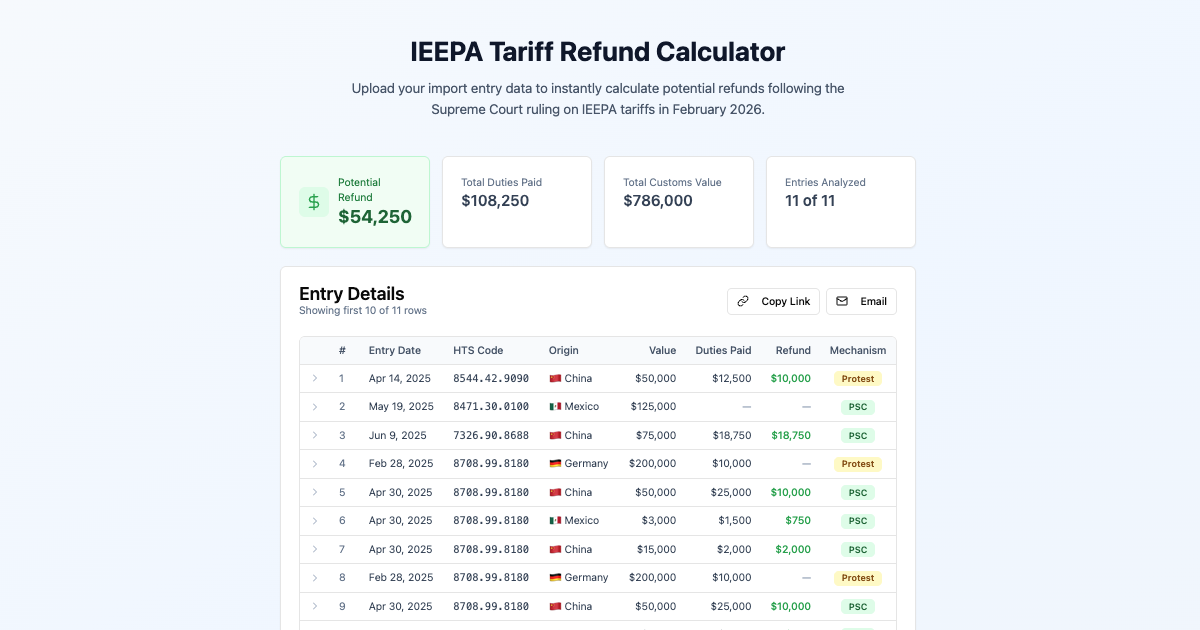
By Sunday night, we had a free tool live at refunds.wove.com that lets any importer upload their entry data and see exactly what they're owed — entry by entry, with the recovery mechanism (PSC, Protest, or CIT Litigation) for each one.
A lot of tools came out this week claiming to calculate refund exposure. Most of them are applying a flat rate to a customs value and calling it a calculation. Ours is not.
Here's what it actually took to build a real tariff refund calculator.
The Problem Nobody Talks About: Tariff Rates Changed 30+ Times
The first thing you need to understand is that IEEPA tariff rates were not static. Over the past year, rates changed by country, by HTS chapter, and by effective date — 35 times in total. China went from 20% to 145% and back down. Canada and Mexico had their own rate schedules. Most countries were subject to a baseline 10% with specific carveouts.
Every other tool we've seen applies a single flat rate. That's not a refund calculator. That's a rough estimate that will be wrong for the majority of entries.
Getting the calculation right means knowing exactly which rate was in effect on the exact date of each import entry. To do that, we had to ingest all 35 tariff schedules — parsing Federal Register notices, reconciling conflicting effective dates, and mapping every rate change to the correct HTS chapter, country of origin, and date window.
That alone required a full day of engineering work.
We Had to Build a PDF Parser from Scratch
The HTS code system doesn't just live in spreadsheets. Chapter notes — the legal language that determines how goods are classified — are published as PDFs by CBP. To build a classification engine that's actually defensible, you need to understand those notes.
We built a custom PDF parser to extract chapter notes from each HTS chapter PDF. This is the kind of infrastructure work that nobody sees but that makes the difference between a tool that produces a number and a tool that produces a defensible number.
When CBP audits a refund claim, they don't just look at what rate you applied. They look at whether your HTS classification was correct in the first place. A misclassified entry doesn't just affect your refund — it creates audit exposure. Our parser is the foundation of the classification accuracy layer that sits underneath the refund calculator.
Chapter 99 Overlay Codes Are Where Most Tools Fall Short
IEEPA tariffs weren't applied directly to standard HTS codes. They were applied via Chapter 99 overlay codes — the 9903.88.xx series for China, with separate series for other countries. An entry might have a standard HTS code of 8471.30.0100 (laptop computers) plus a Chapter 99 overlay of 9903.88.03 representing the specific IEEPA tranche that applied.
Getting the refund calculation right means identifying which Chapter 99 code was applied to each entry and what rate it carried on the date of entry. We show this breakdown at the entry level — so importers and their brokers can see exactly what's driving the refund number, not just a total.
PSC vs. Protest vs. CIT Litigation: The Mechanism Matters
Knowing your refund exposure is only half the picture. Knowing how to recover it is the other half — and the answer depends on the liquidation status of each entry.
Our calculator determines the recovery mechanism for every entry automatically, based on entry date and liquidation status. This is what turns a number into an action plan.
What "Legitimate" Actually Means Here
Justice Barrett called the refund process "a mess" in her concurring opinion. She's right. CBP will hold refund requests to an extremely high standard. Before you file anything, you need clean data, accurate classifications, and documented reasoning.
That's the CBP reasonable care standard — you have to demonstrate a good-faith, documented effort to classify correctly. A spreadsheet of estimated refund exposure doesn't meet that bar. An entry-by-entry breakdown with the specific Chapter 99 codes, effective rates, and recovery mechanisms does.
Wove's refund calculator is built on the same classification infrastructure we use for ongoing compliance work. Every calculation is traceable back to a specific tariff schedule, a specific Federal Register notice, and a specific effective date.
Try It
Upload your import entry data at refunds.wove.com. Free for your first analysis.
If you have significant exposure and want a full classification audit of your historical entries — the kind of documentation that will hold up if CBP comes asking questions — reach out to us directly at wove.com.
The refund window is open. The companies that act now, with accurate data, will be in the best position when formal guidance from CBP arrives.
Wove is an AI-powered trade compliance platform serving freight forwarders, customs brokers, and importers. Our HTS classification engine and tariff calculator are available at tariffs.wove.com.